
How to Calculate GPA at NUS
Short answer: At NUS, GPA is a Unit-weighted average on a 5.00 scale. Multiply each graded course's grade point by its Units, add the points, then divide by total graded Units. S/U courses and other no-grade-point records stay out of the math.
The NUS formula in plain English
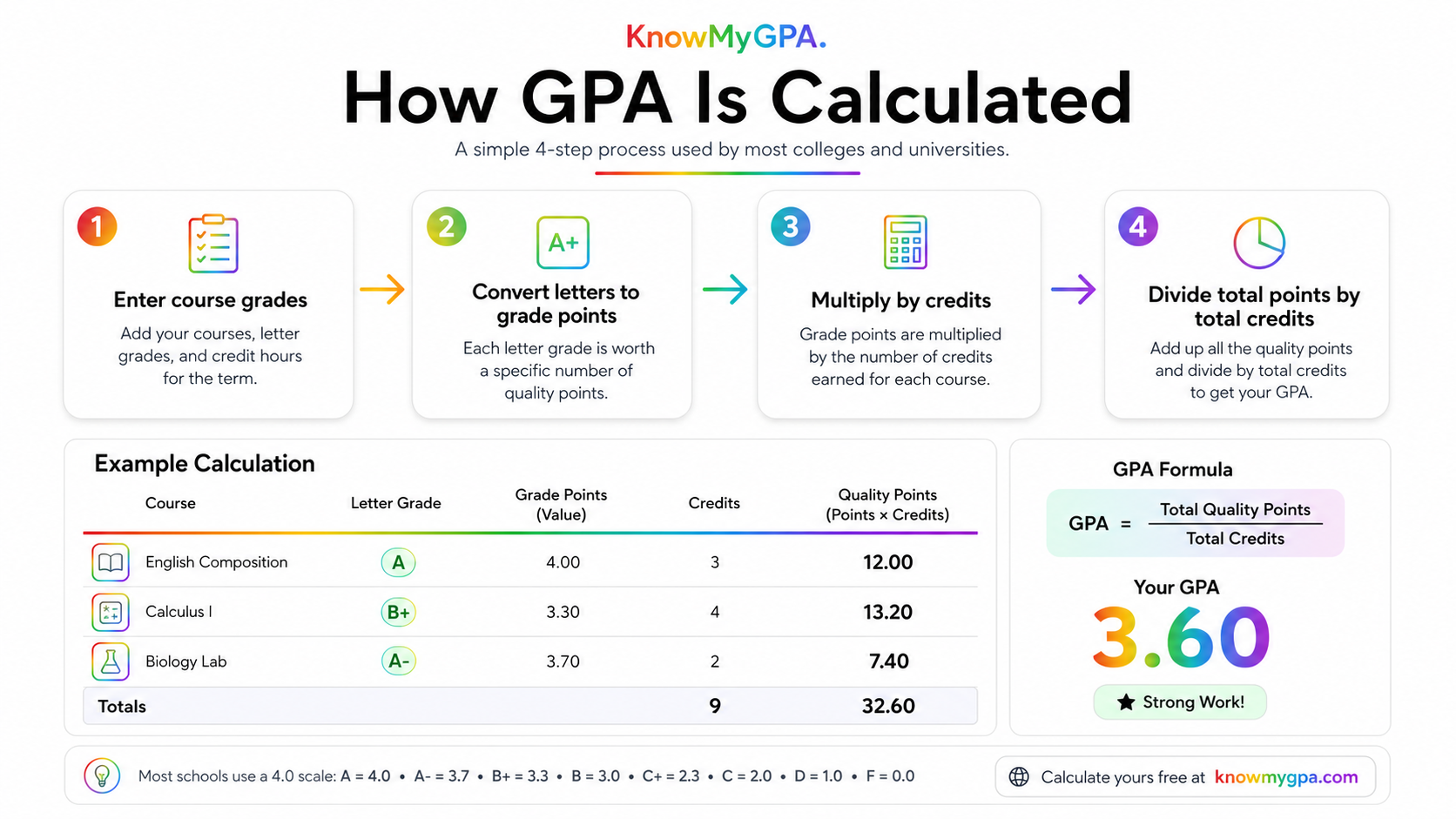
NUS GPA is not a mystery number. It is the weighted average of your graded courses. The weight is the number of Units attached to each course. That matters because a 4-Unit course has twice the pull of a 2-Unit course, and a heavy course can move your GPA more than a small elective. The official idea is: course grade point times course Units, all added together, divided by the total graded Units.
NUS GPA = sum(grade point x Units) / sum(graded Units)
The words have changed over time. NUS renamed Modular Credits to Units, and CAP to GPA, so older pages and student screenshots may still say MCs or CAP. The math is the same kind of weighted average; the current label is GPA.
NUS grade points
The important thing to notice is that A+ and A both carry 5.0 at NUS. That means an A+ can look excellent on the transcript, but it does not push the GPA higher than an A in the calculation. B+ is 4.0, B is 3.5, B- is 3.0, and the scale continues downward until F at 0.0.
| Grade | Grade point | Grade | Grade point |
|---|---|---|---|
| A+ | 5.0 | C+ | 2.5 |
| A | 5.0 | C | 2.0 |
| A- | 4.5 | D+ | 1.5 |
| B+ | 4.0 | D | 1.0 |
| B | 3.5 | F | 0.0 |
| B- | 3.0 |
A worked NUS GPA example
Say you took four graded courses, each worth 4 Units: A, A-, B+, and B. The A gives 5.0 x 4 = 20 grade points. The A- gives 4.5 x 4 = 18. The B+ gives 4.0 x 4 = 16. The B gives 3.5 x 4 = 14. Add those and you get 68 grade points across 16 graded Units. Divide 68 by 16 and the GPA is 4.25.
Now notice why you should not simply average letter grades in your head. If the B course was 8 Units instead of 4, the result would be lower because that B carries more weight. If one course was S/U, it would be excluded from the GPA calculation instead of being treated as a low or high grade.
What to leave out
Courses that do not carry grade points do not belong in the GPA numerator or denominator. That includes S/U courses and other records where NUS does not assign grade points, such as some completed-or-uncompleted, audit, exemption, in-progress, or withdrawn outcomes. The mistake students make is keeping the Units in the denominator after the grade points disappear. Do not do that. If a course has no grade point, leave both its Units and grade points out of the GPA calculation.
How to calculate semester GPA versus overall GPA
For one semester, use only that semester's graded courses. For cumulative GPA, use every graded course that counts toward the cumulative record. Do not average semester GPAs directly unless every semester has the same number of graded Units. A 4.50 GPA from 12 Units and a 4.00 GPA from 24 Units do not average to 4.25. The second semester has twice the weight, so you need to combine the underlying Units.
How to use the NUS calculator correctly
Open the NUS GPA Calculator, enter each graded course, choose the letter grade, and enter the Units. Skip S/U courses. If you are planning a future semester, enter realistic target grades instead of fantasy grades. The calculator is most useful when it helps you see leverage: which course actually moves the GPA, which one is too small to matter much, and which grade target is worth protecting.
Planning a target GPA at NUS
The most useful way to use GPA math is not after the semester is over. It is before the semester becomes impossible to rescue. If you know your current GPA and completed graded Units, you can estimate what future grades would do. A student with many completed Units will see the cumulative GPA move slowly, while a Year 1 student can still move the number quickly. That is not unfair; it is just weighted-average math.
For planning, separate your courses into three groups. First are heavy graded courses that can move the GPA. Second are small courses that matter but have less leverage. Third are S/U or no-grade-point courses that affect workload but not the GPA calculation. This stops you from spending all your emotional energy on the wrong course. If a 4-Unit course is slipping from B+ to B-, it deserves more attention than a tiny course that will not move the cumulative number much.
That is the little discipline that makes GPA planning useful: you are not just asking what the number is, you are deciding where effort has the highest return.
How NUS GPA feels different from percentage systems
Students coming from percentage-based exams often try to ask what 80%, 85%, or 90% "is" in NUS GPA. That is not always the cleanest way to think. NUS GPA is based on the assigned letter grade and grade point, not a universal percentage conversion. Your module's assessment, bell curve or moderation practice, and final grade assignment determine the letter grade. Once the grade is assigned, the GPA math is mechanical.
Common mistakes that create the wrong number
The first mistake is using a US 4.0 conversion chart for an NUS transcript. NUS uses a 5.0 scale, so a B+ is 4.0 at NUS, not the same thing as a B+ on every US chart. The second mistake is counting S/U Units as if they still affect GPA. The third mistake is treating A+ as above A, when both are 5.0 for NUS GPA. The fourth mistake is forgetting that Units matter more than the number of courses.
Use the official record as the final truth. This guide and calculator are planning tools, not a replacement for the registrar. But for quick planning, the weighted formula above gets you very close to the number students actually need to understand.
Sources checked

Written by ShaheryarFounder, KnowMyGPA. I build these guides for students who need a clear answer, a correct calculator, and a real next step without digging through policy pages.
Use the NUS GPA calculator
If you have your grades and Units ready, the NUS calculator is faster than rebuilding the formula by hand.
Open the NUS GPA Calculator