
What GPA Is 5 A's and 3 B's?
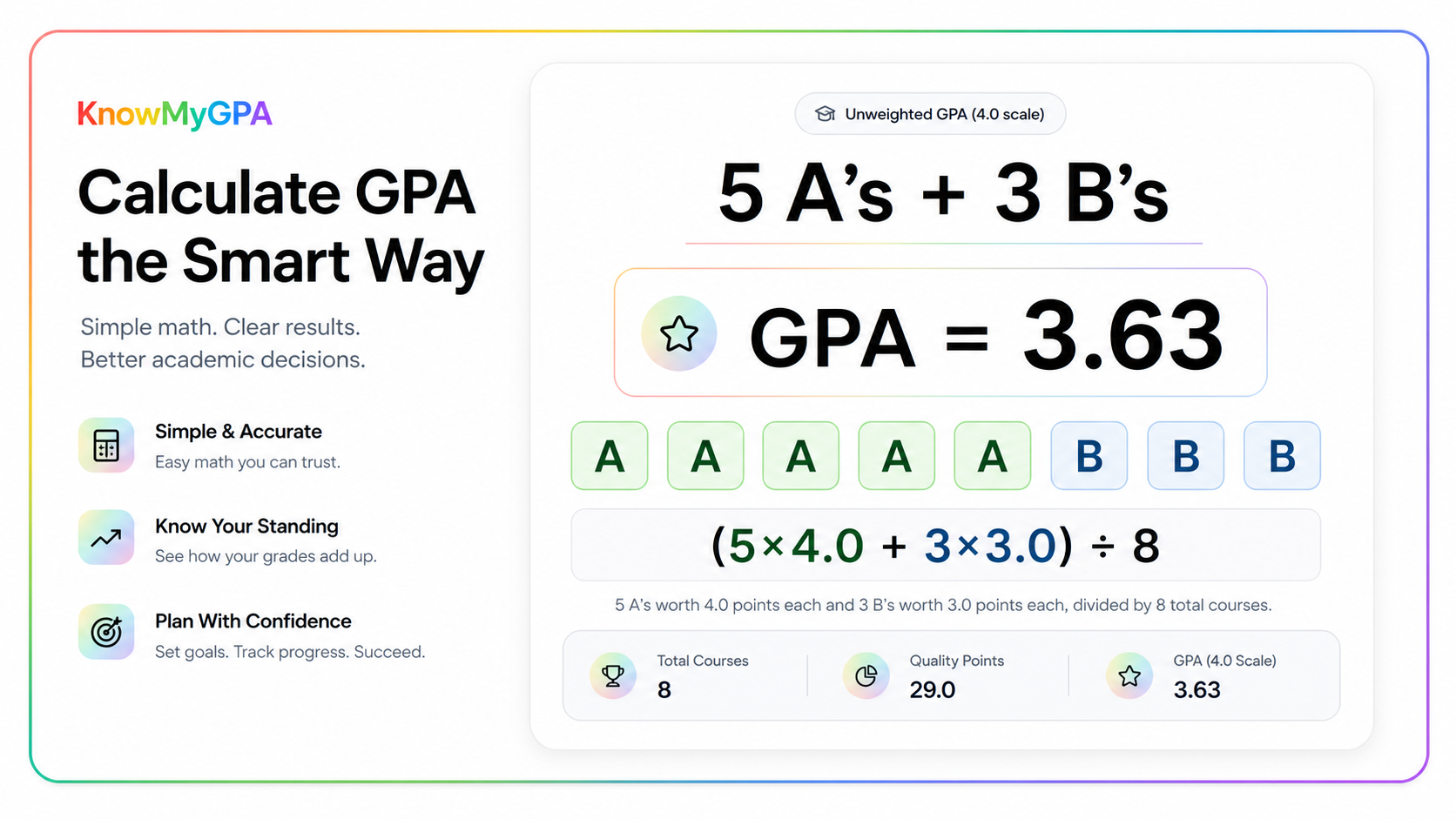
5 A's and 3 B's is a 3.63 GPA if all eight classes are worth the same credits and your school uses A = 4.0 and B = 3.0. The math is (5 x 4.0 + 3 x 3.0) / 8 = 3.625, which rounds to 3.63.
Quick answer
If you have five A's and three B's, your GPA is usually 3.63 on the standard unweighted 4.0 scale, assuming every class counts equally.
That is not just "fine." It is a strong record. A 3.63 means your grades are clearly above a B+ average and close to A- territory. You have more A's than B's, and the B's are not dragging the number into a risky range. For a lot of students, this is the kind of GPA that keeps scholarships, honors options, internships, and college applications alive.
The tiny catch is that GPA is not always a simple vote count. Credits matter. Plus-minus grades matter. Weighted classes matter. Your school may also round differently. So 3.63 is the clean answer, but the exact transcript answer depends on how your classes are counted.
| Grades | Equal-credit GPA | Simple meaning |
|---|---|---|
| 5 A's + 3 B's | 3.63 | Strong B+/A- range average |
| 5 A's + 3 B+'s | 3.74 | Very close to A- range |
| 5 A-'s + 3 B's | 3.44 | Still solid, but below 3.5 |
| 5 A's + 3 B-'s | 3.51 | Good, but the minus grades matter |
The formula
On the common 4.0 scale, an A is worth 4.0 grade points and a B is worth 3.0 grade points. Five A grades create 20 grade points. Three B grades create 9 grade points.
(5 x 4.0) + (3 x 3.0) = 20 + 9 = 29 grade points
You have eight classes total, so divide by eight:
29 / 8 = 3.625
Most schools show GPAs to two decimal places, so 3.625 becomes 3.63 GPA. If a school truncates instead of rounding, it may show 3.62. That is uncommon for public-facing GPA explanations, but transcripts can have their own formatting rules.
Is 5 A's and 3 B's good?
Yes. A 3.63 GPA is good. In high school, it usually signals that you are performing above average, especially if those A's are in core academic classes or harder courses. In college, it is usually strong enough to clear many scholarship, internship, and graduate-school screening floors, though selective programs may still care deeply about your major GPA, course rigor, test scores, portfolio, or experience.
The most honest way to read a 3.63 is this: you are not in recovery mode; you are in optimization mode. The question is less "am I cooked?" and more "which one or two grades would move me from strong to very strong?" That is a much better problem to have.
There is also a human side here. Students often search this question after seeing a mix of grades and feeling like the B's ruined the semester. They did not. Three B's can feel loud because they are the grades you remember, but five A's are doing a lot of work. The overall average is still strong.
How it compares to 4 A's and 3 B's
Four A's and three B's is about a 3.57 GPA. Five A's and three B's is about a 3.63. That extra A moves the average up because it adds another 4.0 grade point to the mix.
The difference may look small, but it can matter around cutoffs. A 3.57 and a 3.63 are both good, but 3.63 is a little more comfortable if you are trying to stay above 3.6, qualify for a merit requirement, or keep a transcript looking clearly above the B+ range.
Credits can change the answer
The 3.63 answer assumes each class has equal weight. That is true in some high-school situations, but in college, classes often have different credit hours. A B in a 4-credit lab science course affects your GPA more than an A in a 1-credit seminar.
The real GPA formula is:
GPA = total quality points / total credits
Quality points are grade points multiplied by credits. An A in a 3-credit class gives 12 quality points. A B in a 3-credit class gives 9 quality points. The letter matters, but the credit weight tells you how loud that letter is.
Example where the GPA is lower than 3.63
Suppose your three B's are in heavier 4-credit classes, and your five A's are in lighter 3-credit classes:
- Five A's in 3-credit classes: 5 x 4.0 x 3 = 60 quality points
- Three B's in 4-credit classes: 3 x 3.0 x 4 = 36 quality points
- Total: 96 quality points across 27 credits
96 / 27 = 3.56 GPA
That is still good, but it is lower than 3.63 because the B grades are carrying more credit weight.
Example where the GPA is higher than 3.63
Now flip the weight. Suppose your A's are in 4-credit classes and your B's are in 3-credit classes:
- Five A's in 4-credit classes: 5 x 4.0 x 4 = 80 quality points
- Three B's in 3-credit classes: 3 x 3.0 x 3 = 27 quality points
- Total: 107 quality points across 29 credits
107 / 29 = 3.69 GPA
Same letters, better credit distribution. This is why two students with the same count of A's and B's can have different GPAs.
What if your grades are A-, B+, or B-?
If your school uses plus-minus grades, do not treat every A-looking grade as 4.0 or every B-looking grade as 3.0. An A- is often 3.7, a B+ is often 3.3, and a B- is often 2.7. Those small decimals add up across eight courses.
| Grade pattern | Equal-credit GPA | Why it changes |
|---|---|---|
| 5 A's + 3 B's | 3.63 | A = 4.0, B = 3.0 |
| 5 A-'s + 3 B's | 3.44 | A- is usually 3.7 |
| 5 A's + 3 B+'s | 3.74 | B+ is usually 3.3 |
| 5 A+'s + 3 B's | 3.63 or 3.83 | Depends whether A+ is capped at 4.0 or worth 4.3 |
Most standard 4.0 scales cap A+ at 4.0, but some universities and application services use a higher A+ value. If A+ appears on your transcript, use your school's official scale instead of guessing.
What if this is a weighted high-school GPA?
For unweighted GPA, five A's and three B's is 3.63. For weighted GPA, the answer depends on which classes are weighted and how your school weights them. Many high schools add extra points for Honors, AP, IB, or dual-enrollment classes. A common pattern is +0.5 for Honors and +1.0 for AP or IB, but schools vary a lot.
That means five A's and three B's could be higher than 3.63 if some of the A's are in weighted classes. It could also be only slightly higher if the weighted classes are the B's. Weighted GPA is powerful, but it is not magic; the course level and credit weight both matter.
What should you do with a 3.63?
If this is your current semester GPA, protect it first. Do not let the A's slip while chasing one B. The easiest mistake is turning two A's into A-'s while trying to turn one B into a B+. That can cancel out the win.
Then look for the highest-leverage class. If one B is in a higher-credit course, improving that grade has the biggest effect. If all credits are equal, improving any B to an A would move the equal-credit GPA from 3.63 to 3.75. That is a real jump.
If this is part of a cumulative GPA, the next move depends on how many total credits you already have. A new strong semester moves a freshman GPA a lot. It moves a senior GPA less, because there are more past credits in the average. That is not discouraging; it just means the plan has to match the math.
Bottom line
5 A's and 3 B's is a 3.63 GPA on the standard 4.0 scale when every class counts equally. It is a strong GPA and usually a good academic signal. The exact number can shift if your classes have different credits, if your school uses plus-minus grades, or if you are calculating a weighted high-school GPA.
If you want the exact transcript-style number, use the GPA calculator and enter each course with its credits. That gives you the real answer instead of the clean shortcut.

Written by ShaheryarFounder, KnowMyGPA. I build these guides for students who need a clear answer, a correct calculator, and a real next step without digging through policy pages.
Calculate it with your real credits
If your A's and B's have different credit hours, the exact GPA may not be 3.63. Enter each class to get the real number.
Use the GPA Calculator