
What Is a Good GPA in College?
Short answer: A good college GPA is the GPA that keeps your next door open. Around 3.0 is often workable, 3.3 to 3.5 is solid, 3.7+ is strong, and 3.8+ is excellent for competitive paths. But your major, school, trend, and goal matter more than a single label.
Good GPA is not one magic number
The honest answer is more useful than the viral answer: a good GPA depends on what you are trying to do next. A 3.0 can be enough to stay eligible, graduate, and apply for plenty of jobs. A 3.5 can make scholarships, internships, and honors conversations easier. A 3.7 or higher can matter for selective graduate programs and competitive recruiting. But a 3.4 in a demanding major with strong projects may beat a 3.8 with no story, no skills, and no direction.
That is why the best way to read your college GPA is by goal. Your GPA is not a personality score. It is a signal. It tells schools, employers, scholarship committees, and advisors one part of the story: how consistently you handled academic work over time.
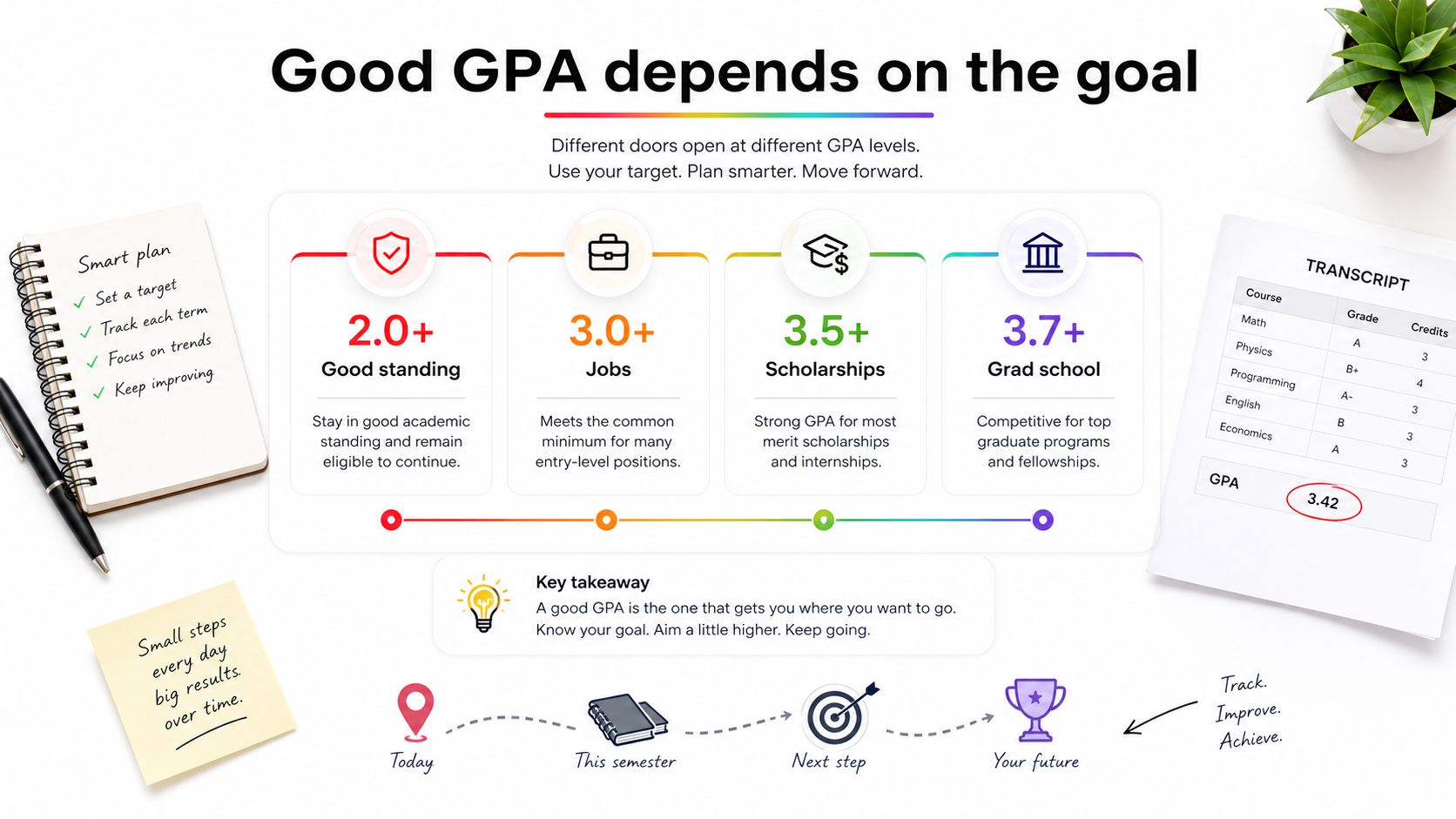
Good college GPA ranges
| GPA range | Plain-English read | What to do next |
|---|---|---|
| Below 2.0 | Danger zone at many colleges | Check academic standing rules immediately |
| 2.0-2.49 | Passing, but limited | Stabilize and retake weak required courses |
| 2.5-2.99 | Workable but not strong | Push toward 3.0 and build experience |
| 3.0-3.29 | Solid baseline | Protect it and improve major GPA |
| 3.3-3.59 | Good to strong | Useful for internships and many scholarships |
| 3.6-3.79 | Very strong | Good position for selective opportunities |
| 3.8-4.0 | Excellent | Protect rigor, research, leadership, and fit |
For jobs, GPA is a filter, not the whole pitch
Employers usually care about proof that you can do the work. GPA can help with the first screen, especially for internships, finance, consulting, engineering pipelines, and early-career roles where students have limited full-time experience. A 3.0 is a common threshold. A 3.5 can look cleaner. But projects, internships, communication, portfolio work, certifications, leadership, and referrals can carry real weight.
If your GPA is strong, list it proudly. If it is below the employer's stated cutoff, do not pretend the cutoff does not exist; build a stronger story around projects and experience. If no GPA is requested and yours does not help, you can often leave it off the resume and lead with skills.
For scholarships, cutoffs can be brutal
Scholarship systems often use hard lines. A 3.49 and a 3.50 may feel almost identical, but the form may not treat them the same. If you are aiming for a scholarship, honors program, or renewal requirement, do the exact math. Do not wait until grades post. Calculate the GPA needed this term and decide which courses have the most leverage.
For graduate school, the trend matters
Graduate programs often look beyond the cumulative number. They may care about major GPA, upper-division courses, research, writing ability, recommendations, work experience, and whether your grades improved. A student who started rough and finished with several strong semesters can look much better than the raw cumulative GPA suggests. That does not mean GPA is irrelevant. It means the trend can help explain growth.
For medical, law, and professional school, use the right calculator
Professional applications may recalculate your GPA. Medical-school services separate science coursework. Law-school services may count repeated attempts differently from your university. PA applications care about several GPA categories and experience hours. If you are heading into a professional application, your transcript GPA is only the starting point. Use the application-service rules, not a generic calculator.
Major difficulty changes the conversation
A good GPA in one major may not read the same in another. Some programs grade tightly. Some have heavy lab sequences. Some schools have strict curves. That is why advisors often look at your course pattern, not just the final number. A 3.2 in a difficult technical major with strong projects may still be a serious candidate for many jobs. A 3.9 in any major is impressive, but it still needs direction.
How to improve a good-but-not-great GPA
Do not try to raise GPA by chasing random easy classes if those classes do not help your degree. Start with high-credit courses, required courses, and repeated low grades if your school has a replacement policy. A three-credit A can help, but replacing a failed or D-range required course can help more if the school allows grade replacement. The fastest path is not always "take more classes." Sometimes it is fewer classes, better grades, and no more academic damage.
What a good GPA looks like by year
A first-year student's GPA is fragile because there are not many completed credits yet. One rough semester can hurt, but one strong semester can also repair quickly. A sophomore's GPA starts to become more stable, and by junior year the cumulative number moves more slowly. Seniors usually need targeted planning because there may not be enough credits left to create a dramatic change.
That is why "good" should be measured against time left. A 2.8 after one semester is a warning, but it is fixable. A 2.8 with one semester left may require a different strategy: explain the trend, show major strength, build experience, or aim at programs where fit matters more than a strict cutoff. A 3.6 early in college is strong, but it still needs protection. The best students do not only chase A's; they protect sleep, deadlines, and course selection so the GPA does not collapse during overloaded terms.
Good GPA by major and difficulty
Some majors have long prerequisite chains, lab courses, studio workloads, clinical requirements, or technical sequences that punish weak foundations. A student in engineering, nursing, computer science, accounting, architecture, or pre-med coursework may read a GPA differently from a student in a program with more flexible electives. This does not mean one major is "better." It means context matters. If your major is known for tough grading, your projects, certifications, portfolio, research, and professor recommendations become even more important.
Major GPA can also matter more than cumulative GPA. If your overall GPA is 3.2 but your upper-level major GPA is 3.7, that tells a better story than the headline number alone. If your cumulative GPA is strong but your major GPA is weak, the opposite can happen. When you talk to advisors or prepare applications, know both numbers.
When a lower GPA is still a strong application
A lower GPA can still work when the rest of the profile is convincing. For jobs, that may mean internships, a portfolio, GitHub projects, clinical hours, design work, sales results, leadership, or strong references. For graduate school, it may mean research, a strong statement, high grades in recent advanced courses, or a clear explanation of what changed. GPA opens doors, but it is not the only key.
The mistake is hiding from the number. If your GPA is below the target, calculate the gap and build evidence around it. If your GPA is already good, do not waste that advantage by having no skills, no projects, and no direction. A GPA is strongest when it supports a larger story: consistent work, useful ability, and a student who knows where they are going.
A better way to ask the question
Instead of asking "is my GPA good?", ask these three questions: is it above the next cutoff, is it improving, and does the rest of my profile support my goal? Those answers are more useful than a generic label. A 3.2 can be good for one goal and weak for another. A 3.7 can be excellent but still not enough by itself for a highly selective path. GPA is a dashboard light. Read it, respond to it, and keep driving.
How to make the next semester count
If your GPA is below where you want it, do not wait for finals week to care. Write down the target GPA, list the courses with the most credits, and decide which grade in each course would actually move the cumulative number. Then build the semester around the first exam, the first project, and the first missed assignment risk. GPA improvement is usually won early. By the time finals arrive, the semester is mostly a consequence of what you protected in weeks two through eight.
If your GPA is already strong, the move is different. Do not overload yourself just because you can. Keep rigor, but protect consistency. Add research, internships, leadership, or portfolio work so your GPA becomes evidence of discipline inside a fuller profile. The students who look strongest are not always the ones with the neatest number; they are the ones whose grades, skills, and direction all point in the same direction.
The healthy way to read your GPA
If your GPA is already high, protect it without becoming fragile. If it is medium, build experience and improve the trend. If it is low, act quickly and mathematically. The number matters, but it is not the whole student. The strongest move is to know what your GPA means, know the next cutoff, and build a plan that makes the next semester cleaner than the last one.
Sources checked

Written by ShaheryarFounder, KnowMyGPA. I build these guides for students who need a clear answer, a correct calculator, and a real next step without digging through policy pages.
Want the exact number?
Use the calculator instead of guessing from a generic chart. Your credits and school scale can change the answer.
Open the GPA Calculator