
Do Colleges Look at Weighted or Unweighted GPA?
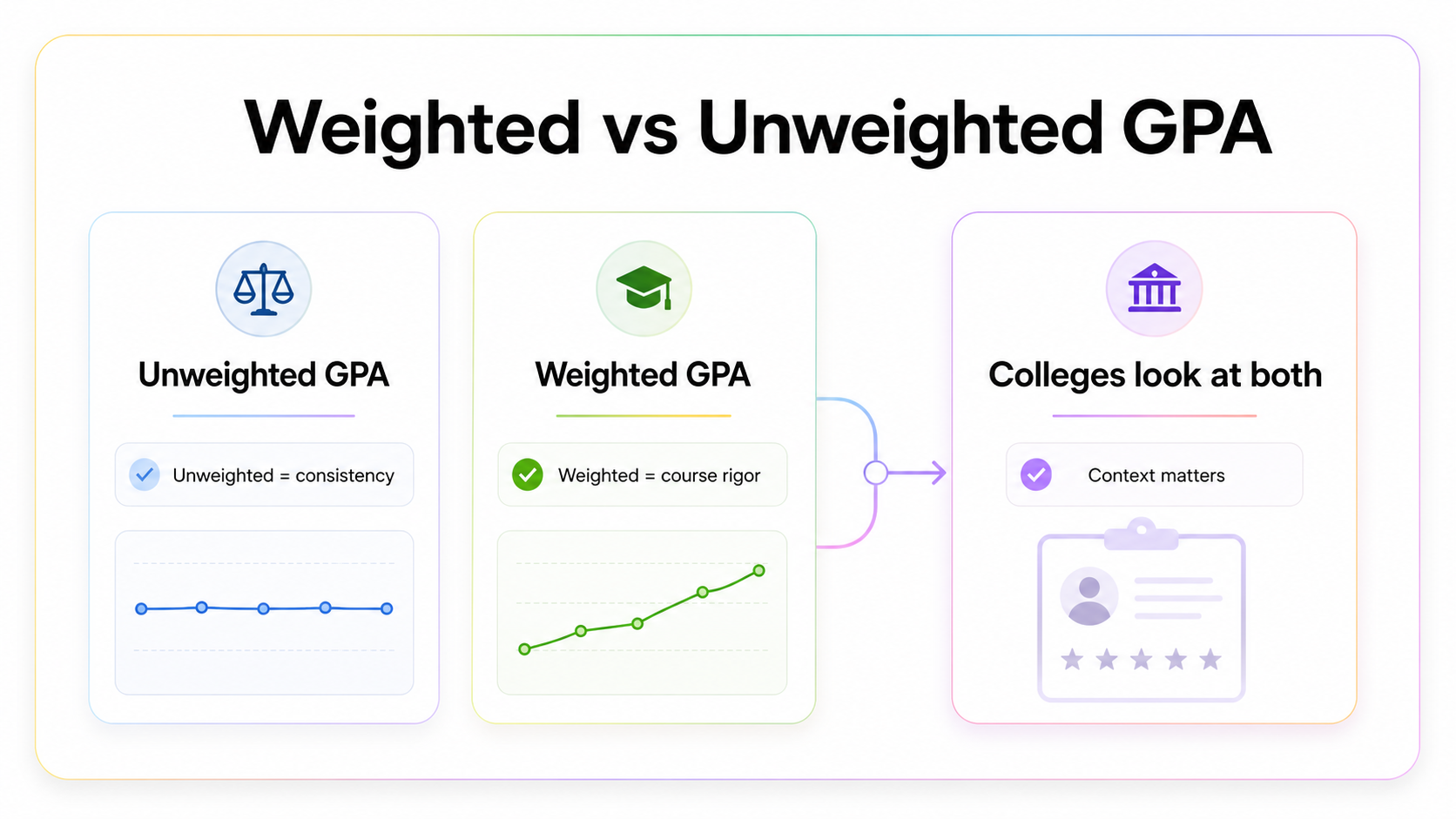
Colleges usually look at both weighted and unweighted GPA. Unweighted GPA helps them compare grades on a cleaner 4.0-style scale, while weighted GPA and your transcript show course rigor. In practice, admissions offices read GPA with context: course difficulty, school profile, grade trend, class rank when available, and the classes tied to your intended major.
Quick answer
Most colleges do not choose only one number and ignore the other. They look at the transcript. That means they can see your unweighted performance, your weighted GPA if your school reports one, the difficulty of your classes, and how your grades changed over time.
The simple version is this: unweighted GPA shows how strong your grades are; weighted GPA helps show how hard your schedule was. Neither number tells the whole story alone.
This is why two students with the same GPA can be read differently. A 3.8 made mostly of standard classes is not the same academic signal as a 3.8 with AP, IB, Honors, dual-enrollment, or the hardest courses available at that school. But a huge weighted GPA does not erase weak grades either. Colleges want rigor and performance together.
| GPA type | What it shows | What it misses |
|---|---|---|
| Unweighted GPA | Grade consistency on a cleaner scale | How difficult the classes were |
| Weighted GPA | Course rigor and advanced classes | Hard to compare across schools |
| Transcript | Grades, course names, rigor, trend | Still needs school context |
| School profile | What courses and weighting were available | Your personal effort outside grades |
Why colleges care about unweighted GPA
Unweighted GPA is useful because it is cleaner. On a common scale, A = 4.0, B = 3.0, C = 2.0, and so on. That makes it easier to see your actual grade pattern without bonus points from course weighting.
Admissions readers need that clarity because high schools weight GPA differently. One school might add 0.5 for Honors and 1.0 for AP. Another might add different values. Another might not weight at all. Some schools cap weighted GPA; others allow numbers above 5.0. If colleges only trusted weighted GPA, comparisons would get messy fast.
That does not mean unweighted GPA is the only thing that matters. It means unweighted GPA is a useful baseline. It answers: when we strip away bonus points, how strong are the grades?
Why colleges care about weighted GPA
Weighted GPA matters because it points toward course rigor. Colleges want to know whether you challenged yourself with the strongest appropriate schedule available to you. A weighted GPA can show that your A's and B's came from harder classes, not only easier ones.
But weighted GPA is not perfect. Since schools calculate it differently, colleges usually read it alongside the transcript and school profile. They are less interested in the raw weighted number alone and more interested in the pattern behind it: Did you take advanced courses? Did you do well in them? Did rigor increase over time? Did you avoid hard classes in subjects related to your intended major?
Some colleges recalculate GPA
Many admissions offices use their own internal review process. Some recalculate GPA using core academic courses. Some emphasize grades from 10th and 11th grade. Some remove non-academic electives. Some look separately at academic GPA and total GPA. Some do not publish the exact formula.
This is not because they are trying to be mysterious. It is because applicants come from thousands of schools with different grading rules. Recalculation helps the college compare students more fairly.
That is also why you should not panic if your school reports a weird weighted scale. Admissions readers usually know how to interpret school profiles. They are trained to read the context behind the number.
What matters most: grades plus rigor
The strongest transcript usually has both: good grades and appropriate challenge. If your unweighted GPA is high and your schedule is rigorous, that is powerful. If your weighted GPA is high because of advanced classes but your unweighted grades are slipping badly, admissions readers may wonder whether the course load was too much. If your unweighted GPA is high but the schedule is light, they may wonder whether you avoided challenge.
The sweet spot is not "take every hard class no matter what." The sweet spot is taking a challenging schedule you can actually handle well. A thoughtful mix beats a heroic overload that crushes your grades and your life.
How this works for selective colleges
At highly selective colleges, course rigor matters a lot because many applicants already have strong grades. A 4.0 unweighted GPA is impressive, but if it came from a schedule with very little rigor at a school that offered many advanced courses, it may not stand out as much as the number suggests.
On the other hand, a slightly lower unweighted GPA with a demanding schedule can still be competitive if the transcript shows strength, intellectual courage, and good performance in hard classes. The exact balance depends on the college, major, and applicant pool.
How this works for less selective colleges
At less selective colleges, GPA still matters, but the review may be more straightforward. A solid unweighted GPA can meet admission or scholarship thresholds. Weighted GPA may help show readiness, but it may not be analyzed as intensely as it is at the most selective schools.
Even there, rigor can help. Strong grades in harder classes can support merit scholarships, honors college admission, competitive majors, or direct-entry programs.
What should you focus on?
If you are choosing classes, do not chase weighted GPA like a video game score. Choose the hardest classes that make sense for your goals and that you can perform well in. If you want engineering, math and science rigor matters. If you want business, strong math and writing can help. If you want pre-med, science performance matters. If you are undecided, a balanced strong core is your friend.
If your GPA is already set, focus on explaining your transcript through the rest of the application. A strong upward trend helps. Better grades in junior year help. Strong grades in major-related courses help. Context can help too, especially if there were real circumstances behind a dip.
Bottom line
Colleges usually look at both weighted and unweighted GPA, but they care most about what those numbers reveal. Unweighted GPA shows grade consistency. Weighted GPA and the transcript show course rigor. The school profile explains what opportunities were available. The best academic signal is not a single number; it is strong grades in an appropriately challenging schedule.
If you want to understand your own numbers, calculate both. Use the GPA calculator for unweighted or credit-based GPA, and the weighted GPA calculator if your school gives bonus points for advanced classes.

Written by ShaheryarFounder, KnowMyGPA. I build these guides for students who need a clear answer, a correct calculator, and a real next step without digging through policy pages.
Compare your GPA both ways
Calculate your unweighted GPA first, then check weighted GPA if your school uses Honors, AP, IB, or dual-enrollment weighting.
Use the Weighted GPA Calculator