
How to Calculate GPA on a 4.0 Scale
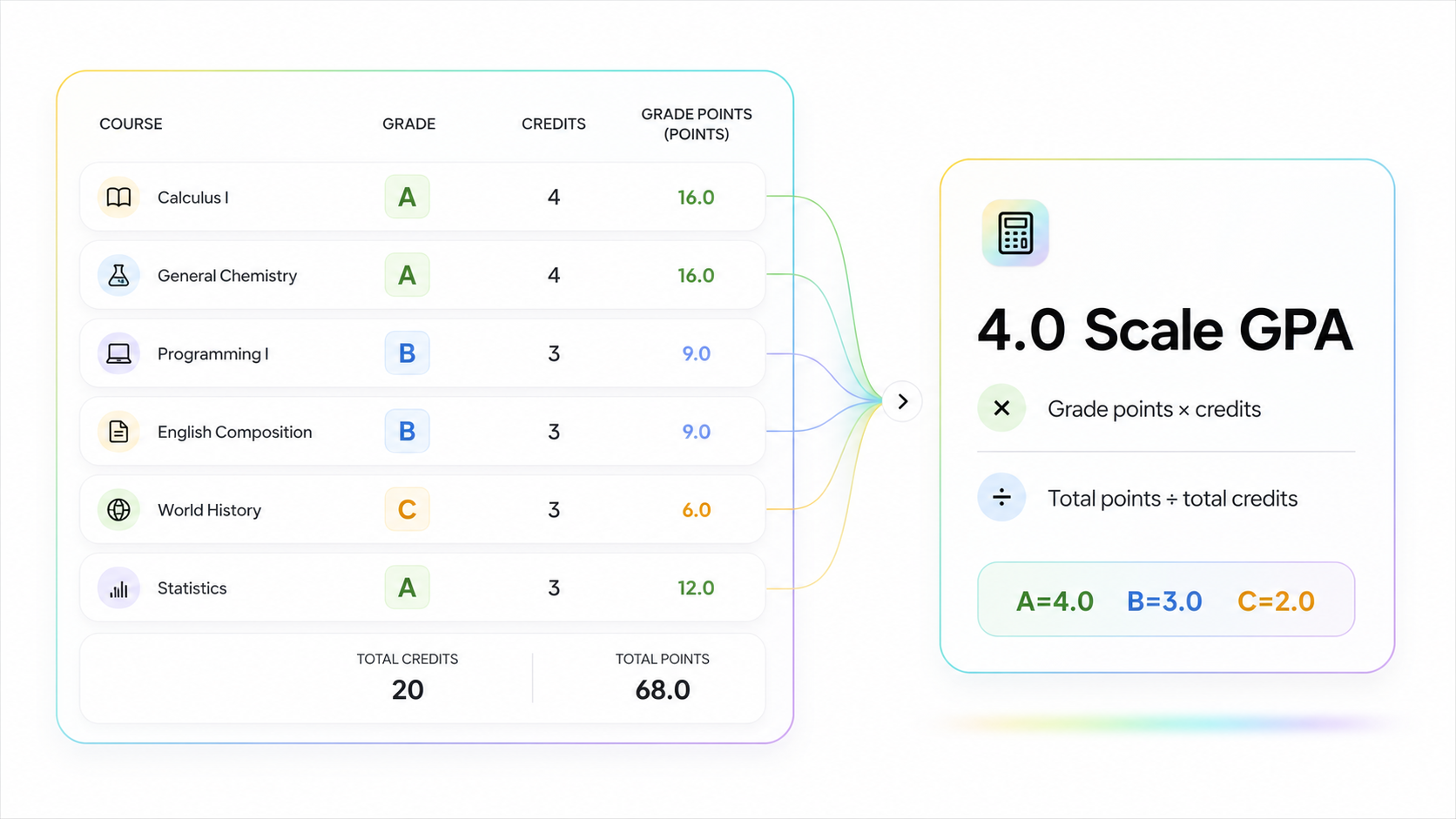
To calculate GPA on a 4.0 scale, convert each grade to grade points, multiply by credits, add the quality points, then divide by total credits. The common shortcut is A = 4.0, B = 3.0, C = 2.0, D = 1.0, and F = 0.0, but your school may use plus-minus grades or a different official scale.
Quick answer
The 4.0 GPA formula is simple once you stop looking at it as a mystery number. Every letter grade becomes a grade-point value. Then credits decide how much that class counts. A high-credit class has a louder voice in your GPA than a low-credit class.
The formula is:
GPA = total quality points / total credits
Quality points are grade points multiplied by credits. If you earn an A in a 3-credit class, that class gives you 12 quality points because 4.0 x 3 = 12. If you earn a B in a 4-credit class, it gives you 12 quality points because 3.0 x 4 = 12. Same quality points, different letter, different credit weight. That is why GPA math rewards both grades and course load.
| Letter grade | Common 4.0 value | Notes |
|---|---|---|
| A | 4.0 | Often the highest value on standard 4.0 scales |
| B | 3.0 | Solid work, one point below A |
| C | 2.0 | Usually passing, but can hurt competitive goals |
| D | 1.0 | Passing at some schools, not enough for some requirements |
| F | 0.0 | No grade points |
Step 1: Convert each grade to grade points
Start by finding the grade-point value for each class. On the common U.S. 4.0 scale, A is 4.0, B is 3.0, C is 2.0, D is 1.0, and F is 0.0. If your school uses plus-minus grades, the table may include values like A- = 3.7, B+ = 3.3, B- = 2.7, and C+ = 2.3.
This is the first place students accidentally get the wrong answer. Do not assume every school treats A+ the same. Many 4.0 scales cap A+ at 4.0. Some schools or application services use 4.3 or 4.33. If the calculation is for your official transcript, your school's scale wins.
Step 2: Multiply grade points by credits
Credits tell you how much each course counts. A 4-credit lab science course usually affects GPA more than a 1-credit seminar. After converting each letter grade to grade points, multiply that number by the course credits.
Quality points = grade points x credits
For example, an A in a 3-credit class gives 12 quality points. A C in a 3-credit class gives 6 quality points. A B in a 4-credit class gives 12 quality points. The letter grade matters, but credits decide the weight.
Step 3: Add quality points and credits
Once every class has quality points, add them together. Then add all attempted GPA credits together. Do not include classes your school excludes from GPA, such as some pass/fail classes, audited classes, withdrawals, or transfer courses that do not carry grade points at your institution.
That last sentence matters. A calculator can only be as accurate as the rules you feed it. Some schools count repeated courses differently. Some replace the old grade. Some average both attempts. Some include failed attempts even when the course was later passed. If you are calculating an official GPA, check the registrar policy.
Worked example
Say your semester looks like this:
| Course | Grade | Credits | Quality points |
|---|---|---|---|
| Calculus | A | 4 | 16.0 |
| English | B | 3 | 9.0 |
| Biology | A | 4 | 16.0 |
| History | C | 3 | 6.0 |
| Statistics | B | 3 | 9.0 |
Total quality points: 56. Total credits: 17.
56 / 17 = 3.294
Rounded to two decimals, the GPA is 3.29. Notice how the 4-credit A grades helped a lot. If the C had been in a 4-credit class instead, the GPA would be lower.
If every class has the same credits
If every class is worth the same number of credits, you can use a faster average. Convert the grades to grade points and average them. For example, A, A, B, B, and C become 4.0, 4.0, 3.0, 3.0, and 2.0.
(4.0 + 4.0 + 3.0 + 3.0 + 2.0) / 5 = 3.20
This shortcut works only when all classes have equal weight. In college, credits often differ, so the full quality-point method is safer.
Common mistakes
The biggest mistake is ignoring credits. The second biggest is using the wrong grade scale. The third is mixing semester GPA and cumulative GPA. Semester GPA uses only the courses in one term. Cumulative GPA combines every GPA-counted course across terms.
Another mistake is counting classes that your school does not count. Pass/fail, transfer, repeated, withdrawn, incomplete, and remedial courses can all have special rules. Your unofficial estimate is useful, but your transcript GPA follows your school's policy.
When the 4.0 estimate is not official
A 4.0-scale GPA estimate is useful for planning, but it is not automatically the same as the number your registrar, high school counselor, scholarship office, or application service will use. Official GPA rules can include repeated-course policies, academic forgiveness, excluded transfer credits, minimum-grade requirements, and separate major GPA calculations.
This matters most when a cutoff is involved. If you need a 3.0 to stay in good standing, a 3.5 for a scholarship, or a specific GPA for a competitive major, do not rely only on the generic scale. Use the calculator to understand the math, then compare it with the rules printed by your school. The goal is not just a nice-looking estimate; the goal is the number that actually counts for your decision.
Bottom line
To calculate GPA on a 4.0 scale, convert grades to points, multiply by credits, add quality points, and divide by total credits. The formula is simple. The accuracy comes from using the right school scale and the right credit rules.
If you want to avoid spreadsheet math, use the GPA calculator and enter each course, grade, and credit value.

Written by ShaheryarFounder, KnowMyGPA. I build these guides for students who need a clear answer, a correct calculator, and a real next step without digging through policy pages.
Calculate your 4.0-scale GPA
Enter your real grades and credits, then see the GPA update instantly.
Use the GPA Calculator