
How to Calculate High School GPA
To calculate high school GPA, convert each final grade to grade points, apply credits if your school uses them, add any approved weighting for Honors/AP/IB classes, then divide by total credits or classes. Unweighted GPA and weighted GPA are different, so calculate the one your school or college actually asks for.
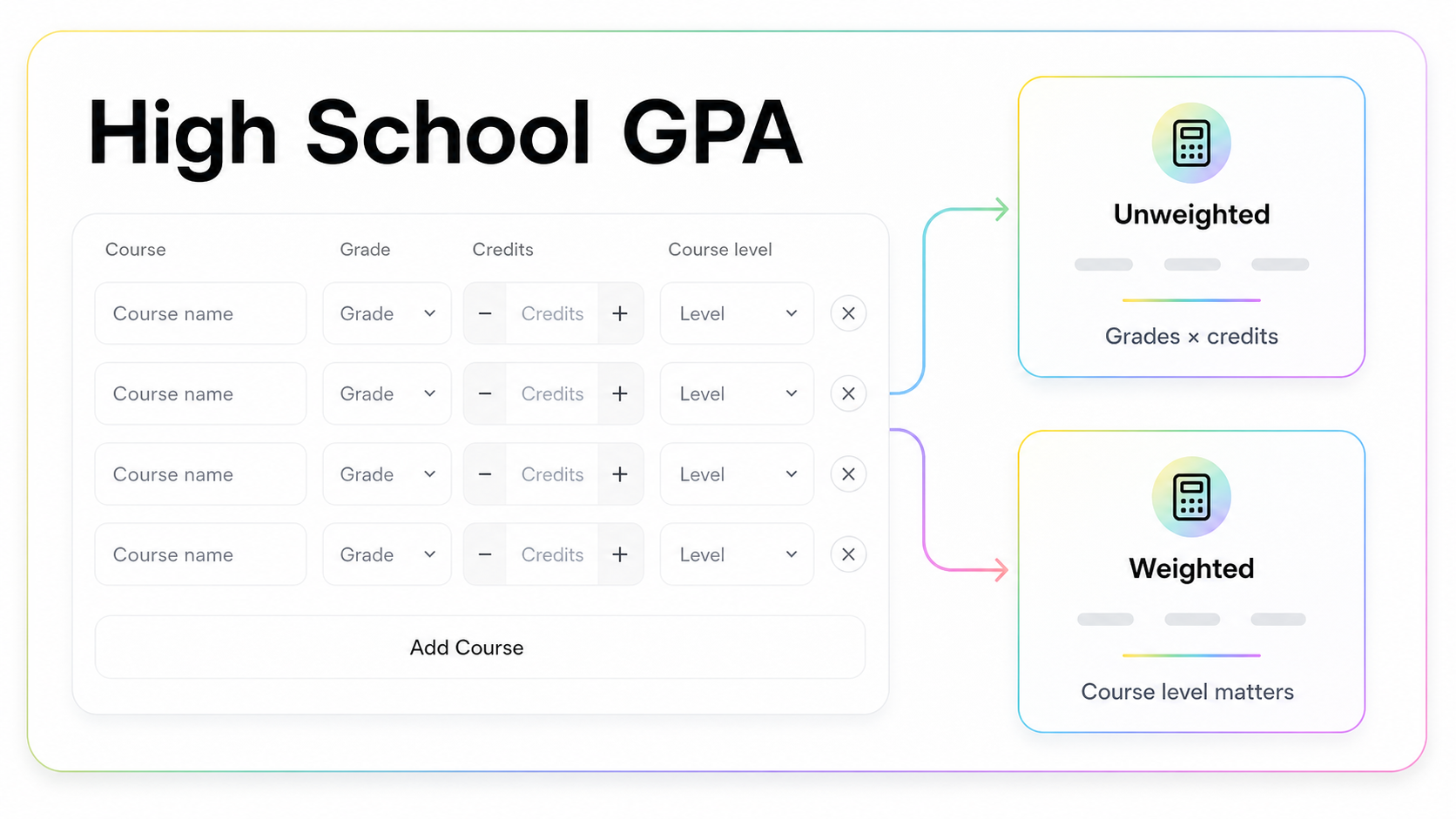
Quick answer
High-school GPA usually comes in two versions: unweighted and weighted. Unweighted GPA treats an A as 4.0 no matter the class level. Weighted GPA can add bonus points for harder classes like Honors, AP, IB, or dual enrollment.
The basic formula is the same:
GPA = total grade points / total classes
or, if your school uses credits:
GPA = total quality points / total credits
The exact method depends on your school. Some high schools count every class equally. Some use credits. Some calculate only core academic classes for certain reports. Some show both weighted and unweighted GPA on the transcript.
Unweighted high-school GPA
Unweighted GPA is the cleanest version. On the common 4.0 scale, A = 4.0, B = 3.0, C = 2.0, D = 1.0, and F = 0.0. If your school uses plus-minus grades, A- might be 3.7, B+ might be 3.3, and so on.
| Grade | Common unweighted value | Meaning |
|---|---|---|
| A | 4.0 | Excellent |
| B | 3.0 | Good |
| C | 2.0 | Passing at many schools |
| D | 1.0 | May not meet some requirements |
| F | 0.0 | No grade points |
Weighted high-school GPA
Weighted GPA gives extra value to harder classes. A common pattern is +0.5 for Honors and +1.0 for AP or IB, but schools vary. At one school, an AP A might be 5.0. At another, it might be 4.5 or handled differently. Some schools do not weight at all.
This is why weighted GPA can be confusing. It is not a universal language. Colleges usually read it with your school profile so they understand how your school weights classes and what advanced courses were available.
Step-by-step calculation
First, list your final grades for the grading period or transcript section you want to calculate. Use final grades, not temporary assignment averages, if you want a transcript-style GPA.
Second, convert each grade to points using your school's scale. Third, apply approved weighting only to classes your school actually weights. Fourth, multiply by credits if your school uses credit weighting. Finally, divide by total classes or total credits.
For an unweighted equal-class example, A, A, B, B, and C become 4.0, 4.0, 3.0, 3.0, and 2.0.
(4.0 + 4.0 + 3.0 + 3.0 + 2.0) / 5 = 3.20
Worked weighted example
Imagine five classes:
| Class | Level | Grade | Weighted points |
|---|---|---|---|
| English | Regular | A | 4.0 |
| AP Biology | AP | B | 4.0 |
| Honors Algebra | Honors | B | 3.5 |
| World History | Regular | A | 4.0 |
| Art | Regular | C | 2.0 |
(4.0 + 4.0 + 3.5 + 4.0 + 2.0) / 5 = 3.50 weighted GPA
The unweighted GPA for the same grades would be 3.20. Same student, same grades, different GPA type.
Semester GPA vs cumulative GPA
Semester GPA uses one term. Cumulative GPA combines all GPA-counted high-school courses over multiple terms or years. A strong new semester can move your cumulative GPA more when you have fewer completed credits. Later in high school, the cumulative number moves more slowly because there are more past grades in the average.
If you are trying to improve your GPA before applications, calculate both. Semester GPA shows momentum. Cumulative GPA shows the official overall record.
Common high-school GPA mistakes
Students often mix weighted and unweighted GPA without realizing it. Another mistake is using quarter grades when the transcript uses semester grades. Some students count PE, electives, or pass/fail classes incorrectly. Others use AP weighting for a class their school does not actually weight.
The best move is to use your school handbook or transcript rules. A generic calculator can estimate the math, but your school's policy decides the official transcript GPA.
How to use this for college planning
For college planning, calculate both unweighted and weighted GPA if your school reports both. Unweighted GPA helps you understand pure grade strength. Weighted GPA helps show whether you challenged yourself with harder courses. Colleges usually read those numbers with your transcript, school profile, course rigor, and grade trend.
If your GPA is lower than you want, do not just stare at the cumulative number. Find the fastest lever. A high-credit C may matter more than a low-credit B. A new strong semester can show improvement even before the cumulative GPA fully catches up. If your school has retake rules, one repeated course may change the plan. GPA improvement is not vibes; it is targeted math.
How GPA changes by grade level
If you are a freshman, your GPA can still move quickly because there are not many completed credits yet. One strong semester can change the average a lot. If you are a sophomore, you still have room, but consistency starts mattering more. If you are a junior, every semester is important because colleges often pay close attention to junior-year grades. If you are a senior, your cumulative GPA is harder to move, but strong senior grades can still help with applications, waitlists, scholarships, and avoiding problems after admission.
That is why the best GPA plan changes with timing. Early students should build clean habits and avoid low grades becoming part of the transcript. Juniors should protect core academic classes and show rigor. Seniors should keep grades stable, especially in classes connected to their intended major. The math is the same, but the strategy changes depending on how many credits are already locked in.
Bottom line
To calculate high-school GPA, decide whether you need unweighted or weighted GPA, convert final grades to grade points, include credits or course levels if your school uses them, then divide by total classes or credits. The math is simple. The accuracy comes from using your school's real rules.

Written by ShaheryarFounder, KnowMyGPA. I build these guides for students who need a clear answer, a correct calculator, and a real next step without digging through policy pages.
Calculate your high-school GPA
Use the high-school GPA calculator if your classes include Honors, AP, IB, or weighted levels.
Use the High School GPA Calculator