
What Does GPA Stand For?
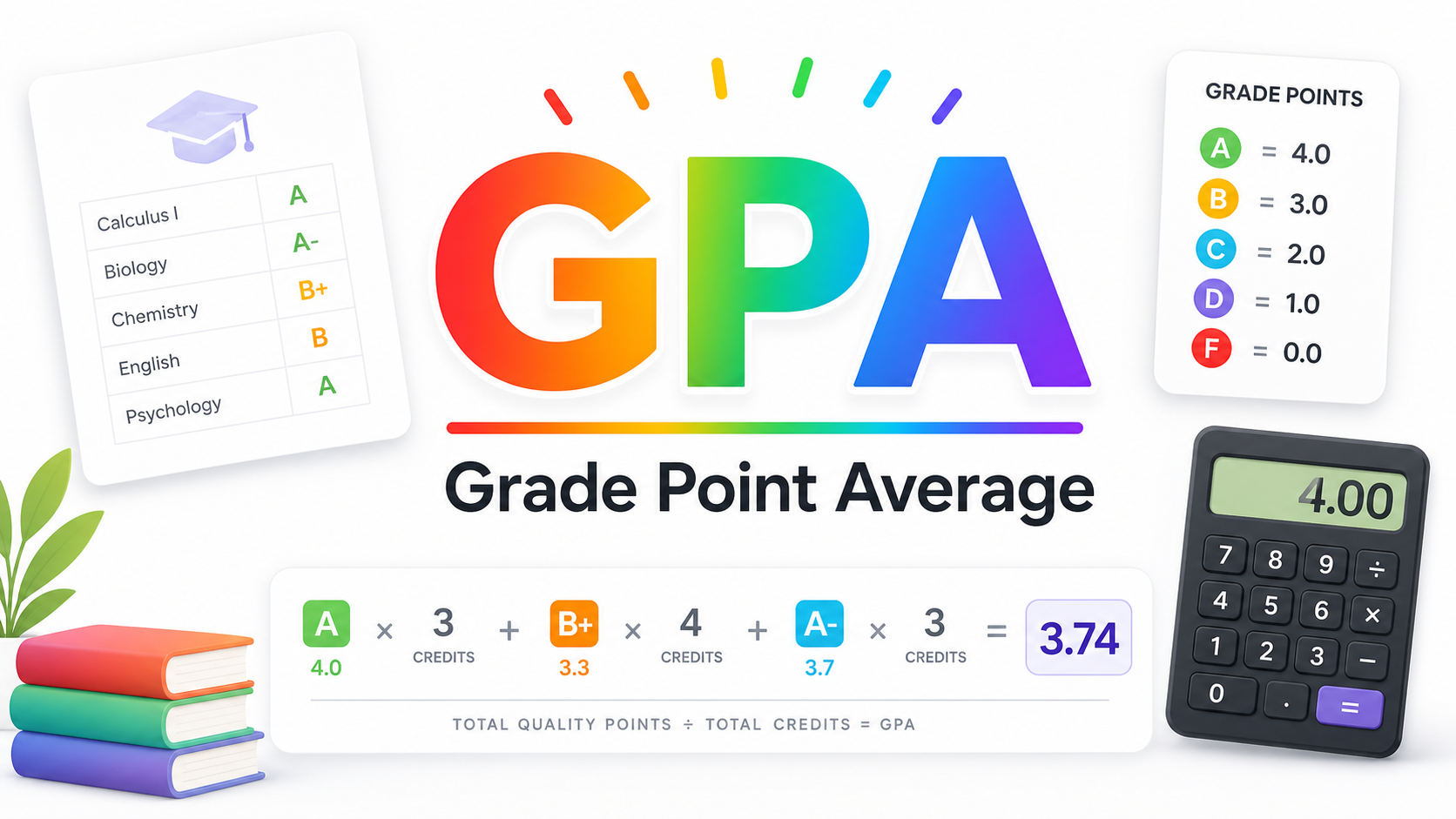
GPA stands for Grade Point Average. It is a number that summarizes your grades by converting each class grade into grade points and averaging them, often on a 4.0 scale in the United States.
The simple meaning
GPA stands for Grade Point Average. That sounds official and a little dry, but the idea is simple: schools need one compact number that represents how you performed across multiple classes. Instead of only seeing English A, Biology B+, History A-, and Algebra B, GPA turns those grades into points and averages them.
On the common US 4.0 scale, an A is usually worth 4.0 points, a B is usually worth 3.0 points, a C is usually worth 2.0 points, a D is usually worth 1.0 point, and an F is worth 0.0 points. If a school uses plus and minus grades, B+ might be 3.3, B- might be 2.7, and A- might be 3.7. That point system is the bridge between letter grades and the final GPA number.
The important thing: GPA is not a personality score, a life sentence, or a full picture of your ability. It is a school math summary. Useful? Absolutely. Perfect? No. It misses course difficulty, grading strictness, illness, family pressure, improvement over time, and a hundred other real-life details. But colleges, scholarships, employers, and graduate programs still use it because it is quick to compare.
How GPA is calculated
The basic GPA formula is:
GPA = total grade points / number of classes
If your classes have credit hours, the better formula is:
GPA = total quality points / total credits
Quality points mean grade points multiplied by credits. A 4.0 A in a 3-credit class gives 12 quality points. A 3.0 B in a 3-credit class gives 9 quality points. Add the quality points, add the credits, divide, and you get the GPA.
| Grade | Common points | Meaning |
|---|---|---|
| A | 4.0 | Excellent work |
| B | 3.0 | Good work |
| C | 2.0 | Average or passing work at many schools |
| D | 1.0 | Low passing at some schools |
| F | 0.0 | Failing grade |
Why GPA matters
GPA matters because it gets used as a quick academic filter. Colleges may use it to understand readiness. Scholarship committees may set minimum GPA requirements. Universities may use it for dean's list, honors, academic probation, graduation checks, and program admission. Employers may ask for it in internships or early-career hiring, especially when students do not have much work experience yet.
But the number is most useful when you connect it to a goal. A 2.8 GPA can be perfectly workable for one path and too low for another. A 3.5 can be strong for many college situations but not enough by itself for the most selective scholarships or graduate programs. GPA only becomes meaningful when you ask, "meaningful for what?"
Weighted vs unweighted GPA
An unweighted GPA usually treats each grade on the same 4.0 scale. An A in a regular class and an A in an AP class may both count as 4.0.
A weighted GPA gives extra value to harder classes, usually Honors, AP, IB, or dual-enrollment courses. A school might count an A in AP Chemistry as 5.0 instead of 4.0, or add 0.5 for Honors and 1.0 for AP. This is why some students have GPAs above 4.0.
Neither version is "fake." They answer different questions. Unweighted GPA asks, "How strong were the grades?" Weighted GPA asks, "How strong were the grades while considering course difficulty?" Colleges often look at both.
Cumulative GPA vs semester GPA
Your semester GPA is the average for one term. Your cumulative GPA combines multiple terms into one overall number. A strong new semester can lift your cumulative GPA, but the amount depends on how many credits you already have.
This is why GPA recovery feels very different for freshmen and seniors. Early credits are easier to move because there are fewer old credits in the average. Later, the same great semester still helps, but it has to push against more completed coursework.
What GPA does not tell you
GPA does not show whether your school grades harshly. It does not show whether you took the hardest classes available. It does not show whether one bad semester came from a real crisis. It does not show curiosity, creativity, discipline, leadership, or the way a student changed after figuring things out.
That does not make GPA useless. It just means you should read it honestly. Use GPA as a dashboard, not a verdict. If the number is strong, protect it and use it. If the number is weak, diagnose the few courses creating the most damage and build a recovery plan around those.
Bottom line
GPA stands for Grade Point Average. It is a grade summary, usually calculated by converting grades into points and averaging them. The exact system depends on your school, but the purpose is the same: to turn a transcript full of courses into one readable academic number.
If you want your exact number, use the GPA calculator with your real grades and credits. If you are still learning the basics, start with the scale your school uses before comparing your GPA to someone else's.

Written by ShaheryarFounder, KnowMyGPA. I build these guides for students who need a clear answer, a correct calculator, and a real next step without digging through policy pages.
Turn the definition into your actual number
GPA makes more sense once you calculate your own. Add your grades and credits to see the number behind your transcript.
Calculate Your GPA