
What GPA Is 4 A's and 2 C's?
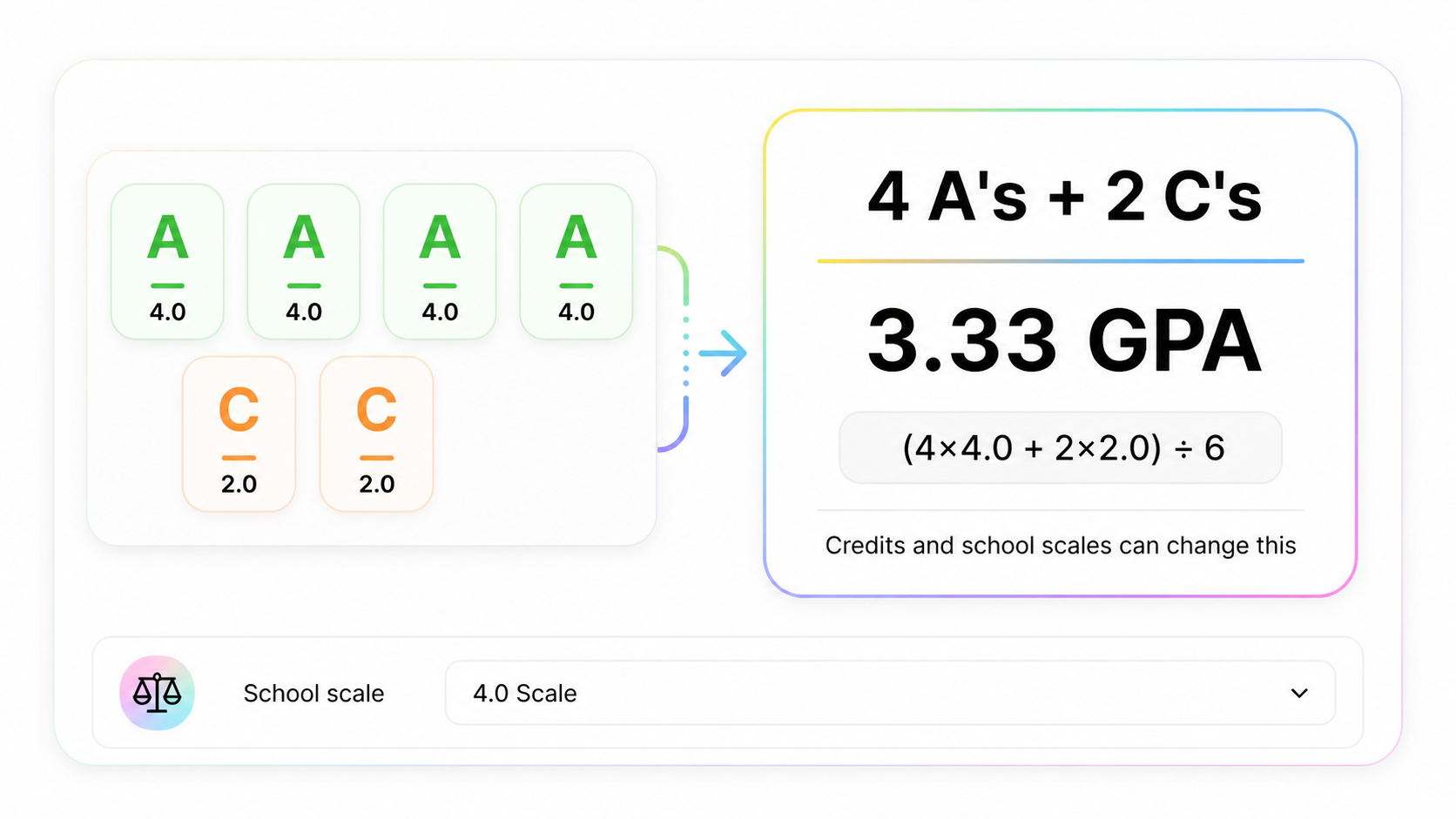
4 A's and 2 C's is about a 3.33 GPA on the common 4.0 scale if all six classes count equally. The math is (4 x 4.0 + 2 x 2.0) / 6 = 3.33. Your official GPA can change if your school uses different grade points, credits, plus-minus grades, or weighting.
Quick answer
If your grades are four plain A's and two plain C's, your GPA is usually 3.33 on a common 4.0 scale, assuming every class has the same credit value.
That answer is stronger than it may feel. Two C's can look scary on a transcript because they stand out, especially next to four A's. But mathematically, the A's are doing a lot of lifting. The final average lands above a B average, not near the danger zone.
Still, the C's matter. They can matter more if they are in high-credit classes, major requirements, prerequisites, or courses your future program cares about. So the honest answer is: 3.33 is the usual shortcut, but your school scale and course context decide the real meaning.
| Grades | Equal-credit GPA | What it means |
|---|---|---|
| 4 A's + 2 C's | 3.33 | Above a B average |
| 4 A's + 2 C+'s | 3.43 | Better if C+ = 2.3 |
| 4 A's + 2 C-'s | 3.23 | Lower if C- = 1.7 |
| 4 A-'s + 2 C's | 3.13 | A- grades pull it down |
The formula
On many 4.0 scales, a plain A is worth 4.0 grade points and a plain C is worth 2.0 grade points. With four A's and two C's, the grade points are:
(4 x 4.0) + (2 x 2.0) = 16 + 4 = 20 grade points
There are six classes total, so divide by six:
20 / 6 = 3.3333
Rounded to two decimals, that is a 3.33 GPA. Some schools round to 3.33, some may display more decimal places, and some official systems use slightly different grade-point tables.
Is 4 A's and 2 C's good?
Usually, yes. A 3.33 GPA is solid. It is above a 3.0, which is an important benchmark for many schools, scholarships, internships, and graduate programs. It says your overall performance is more A/B range than C range.
But this is one of those GPA patterns where the average can hide the story. Four A's says you can do excellent work. Two C's says something got in the way: maybe the class was difficult, maybe the grading was harsh, maybe you overloaded your schedule, or maybe those subjects were not your strength.
That story matters. If the C's are in electives, the GPA may look perfectly fine. If the C's are in required major classes, math prerequisites, lab sciences, or courses tied to a competitive program, they deserve more attention than the 3.33 alone suggests.
Credits can change the answer
The 3.33 answer assumes all six classes count equally. In college, that is not always true. A C in a 4-credit course affects your GPA more than an A in a 1-credit course. A high-credit C can drag the average down harder than students expect.
The real credit-weighted formula is:
GPA = total quality points / total credits
Quality points are grade points multiplied by credits. An A in a 3-credit class gives 12 quality points. A C in a 3-credit class gives 6 quality points. If the C is in a 4-credit class, it gives 8 quality points, but it also takes up more of the denominator.
Example where the GPA is lower than 3.33
Suppose your two C's are in 4-credit classes, while your four A's are in 3-credit classes:
- Four A's in 3-credit classes: 4 x 4.0 x 3 = 48 quality points
- Two C's in 4-credit classes: 2 x 2.0 x 4 = 16 quality points
- Total: 64 quality points across 20 credits
64 / 20 = 3.20 GPA
Same letter grades, lower GPA, because the C's carried more credit weight.
Example where the GPA is higher than 3.33
Now flip it. Suppose your A's are in 4-credit classes and your C's are in 3-credit classes:
- Four A's in 4-credit classes: 4 x 4.0 x 4 = 64 quality points
- Two C's in 3-credit classes: 2 x 2.0 x 3 = 12 quality points
- Total: 76 quality points across 22 credits
76 / 22 = 3.45 GPA
This is why a real GPA calculator needs credits. The count of A's and C's is useful, but credit hours tell you how much each grade actually weighs.
Plus-minus grades can change it too
If your grades are exactly A and C, the 3.33 answer works on many 4.0 scales. But if they are A-, C+, or C-, the result changes. A- is often 3.7, C+ is often 2.3, and C- is often 1.7. Those decimals matter across six classes.
For example, four A's and two C+ grades would often be about 3.43 with equal credits. Four A's and two C- grades would often be about 3.23. Four A- grades and two C grades would often be about 3.13.
Also, not every school uses plus-minus grading. Some schools treat A as 4.0, B as 3.0, C as 2.0, and skip plus/minus points entirely. Others have their own tables. If this GPA is important, use the scale printed in your school catalog or registrar page.
What if this is high school?
For unweighted high-school GPA, four A's and two C's is usually 3.33 on a common 4.0 scale. Weighted GPA can be higher if the A's are in Honors, AP, IB, or dual-enrollment classes. But the C's may still matter if they are in core subjects like math, English, science, social studies, or world language.
Admissions readers usually do not look at GPA as a naked number. They look at course rigor, trend, school context, and the classes where the lower grades happened. A 3.33 with hard classes and improvement can tell a better story than a 3.33 with easy classes and slipping grades.
What if this is college?
In college, a 3.33 semester GPA is generally solid. It is above many good-standing and graduation minimums. But C grades can be more serious when they happen in required courses. Some majors require a minimum grade in prerequisite classes. Some programs require a minimum major GPA, not just overall GPA.
If the C's are in courses you need for your major, check whether they satisfy the requirement. A C may be passing for the university but not enough for a specific program, transfer pathway, scholarship renewal, or graduate-school prerequisite.
How to raise this GPA fastest
The most powerful move is improving a C, not squeezing an already-strong A. With equal credits, changing one C to a B moves the GPA from 3.33 to 3.50. Changing one C to an A moves it to 3.67. That is a huge lift from a single course.
If your school allows retakes and replaces the grade, the C courses are the first place to investigate. If your school averages both attempts, a retake can still help, but less dramatically. Either way, the C's are where the leverage is.
- Check whether either C is required for your major. If yes, prioritize that course first.
- Look at credit hours. A high-credit C is the biggest GPA lever.
- Ask about retake policy. Replacement rules can change the whole plan.
- Protect the A's. Do not let strong classes slip while fixing the weak spot.
Bottom line
4 A's and 2 C's is usually a 3.33 GPA on a common 4.0 scale with equal credits. That is a solid GPA, but the details matter. The official number can change with credit hours, plus-minus grades, weighted courses, retake rules, and school-specific grading systems.
If you want the exact answer for your transcript, use the GPA calculator and enter each class with its credits. The shortcut is helpful, but your school scale is what counts.

Written by ShaheryarFounder, KnowMyGPA. I build these guides for students who need a clear answer, a correct calculator, and a real next step without digging through policy pages.
Calculate it with your real credits
4 A's and 2 C's is usually 3.33, but credits and school rules can move the number.
Use the GPA Calculator