
What Would My GPA Be With All B's?
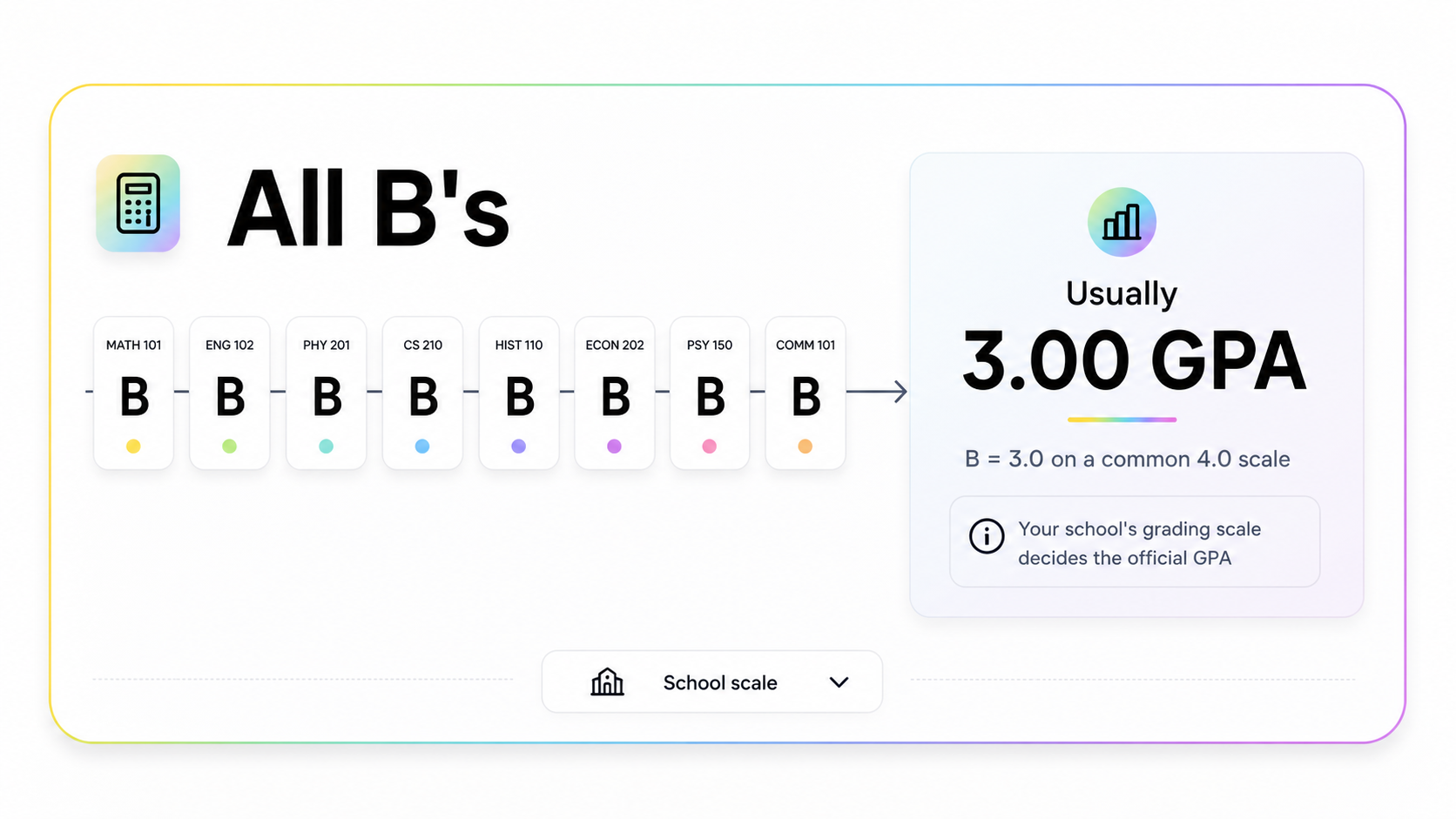
All B's would usually be a 3.00 GPA on the common U.S. 4.0 scale where a plain B is worth 3.0 grade points. But this is not universal: your official GPA depends on your school's grading scale, plus-minus rules, credit system, and whether courses are weighted.
Quick answer
If every grade is a plain B and your school uses the common 4.0 scale, your GPA would usually be 3.00. The shortcut is simple because B = 3.0 on many U.S. grading scales.
But the word "usually" matters here. Not every school uses the same grading system. Some schools use plus and minus grades. Some universities use 10-point CGPA systems. Some high schools weight Honors, AP, IB, or dual-enrollment courses. Some international systems do not translate letter grades to U.S. GPA in a straight line at all.
So the clean answer is: all B's = 3.00 GPA on a standard 4.0 scale. The smarter answer is: check the official scale your school uses before treating 3.00 as your transcript number.
| Situation | Likely GPA | What to check |
|---|---|---|
| All plain B grades on common 4.0 scale | 3.00 | B = 3.0 |
| All B+ grades | Often 3.30 | Whether your school uses B+ |
| All B- grades | Often 2.70 | Whether your school uses B- |
| Weighted high-school B grades | Can be above 3.00 | Honors, AP, IB, or dual-enrollment rules |
The simple formula
On the common 4.0 scale, GPA is the average of your grade points after credits are included. A plain B is usually worth 3.0 grade points. If every class is a B, then every class contributes the same grade point value.
B = 3.0
If you have five classes and all five are B's:
(3.0 + 3.0 + 3.0 + 3.0 + 3.0) / 5 = 3.00
If you have eight classes and all eight are B's, the answer is still 3.00. Ten classes? Still 3.00. The number of classes does not change the average when every grade has the same grade-point value.
Do credits matter if every grade is B?
This is a good little GPA trap. Credits matter a lot when your grades are mixed. But if every course is exactly a plain B and every B is worth exactly 3.0 at your school, credits do not change the GPA. A 1-credit B, a 3-credit B, and a 5-credit B all point to the same 3.0 average if every other course is also a B.
Here is why:
GPA = total quality points / total credits
Quality points are grade points multiplied by credits. If every grade point is 3.0, the math keeps returning 3.0 no matter how the credits are distributed.
The moment one class becomes A, C, B+, B-, pass/fail, repeated, withdrawn, or excluded, credits start mattering again. That is where students often get surprised.
Where the answer changes
The answer changes when your "B's" are not all the same kind of B, or when your school does not use the common U.S. 4.0 setup.
Many colleges use plus-minus grading. In that case, B+ may be 3.3 and B- may be 2.7. If your grades are really all B+, your GPA may be around 3.30. If they are all B-, your GPA may be around 2.70. If you have a mix, your GPA sits somewhere between those numbers.
Other schools use different scales entirely. Some international universities use 10-point CGPA systems. Some schools publish grade points by percentage bands instead of letters. Some professional application services recalculate your grades using their own rules. That is why you should never assume a universal conversion if the result matters for admissions, scholarships, or official reporting.
Is all B's a good GPA?
All B's is usually a solid GPA. A 3.00 often clears basic good-standing requirements at many schools and is a common minimum for internships, graduate programs, scholarships, and major progression. It says you are consistently passing with respectable work, not barely surviving.
But it may not be enough for every goal. Competitive scholarships, honors programs, selective colleges, medical school, law school, some nursing programs, and some graduate admissions paths often expect higher than a 3.0. In those cases, all B's is not "bad"; it is the floor you want to build from.
A better way to think about all B's is this: it is stable, but it is not maxed out. You are not in academic emergency territory. You are in "where can I turn one or two B's into A's?" territory.
What if this is high school?
For unweighted high-school GPA, all plain B's usually means 3.00. If your school reports weighted GPA, the answer can be higher when the B grades are in Honors, AP, IB, or dual-enrollment classes.
For example, a B in a regular class may be 3.0, while a B in an AP class might count as 4.0 on a weighted scale at some schools. But do not assume that rule. High-school weighting policies vary heavily by district.
College admissions offices also know that weighted GPA systems differ. They often look at your transcript, course rigor, school profile, and grades in core subjects instead of blindly comparing one weighted GPA number against another.
What if this is college?
In college, all B's usually means a 3.00 semester GPA on a standard 4.0 scale. That is often enough to stay in good academic standing, but it can be a warning light if your target requires a 3.3, 3.5, or higher.
The important thing is to compare the 3.00 to your actual goal. A 3.00 may be fine for staying eligible. It may be okay for many jobs. It may be low for competitive graduate school, pre-med planning, scholarships, honors, or transferring into a selective major.
If you are early in college, a 3.00 is still very movable. One or two stronger semesters can lift it quickly. If you already have many credits, it takes more A-level work to shift the cumulative number, but it is still math, not magic.
How to raise an all-B GPA fastest
If your current pattern is all B's, the fastest improvement is not usually "try harder everywhere." That is too vague. The smarter move is to identify the course where a realistic jump from B to A is most likely and most valuable.
- Start with high-credit classes. A grade improvement in a 4-credit course moves GPA more than the same improvement in a 1-credit course.
- Look for borderline B's. If an 87 can become a 90, that may be easier than turning an 80 into a 93.
- Protect the B's that could slip. Dropping from B to C hurts just as much as rising from B to A helps.
- Check retake rules. Some schools replace grades after a repeat; others average both attempts. That changes the strategy.
If all your classes are equal credit, changing one B to an A in a five-class semester moves the semester GPA from 3.00 to 3.20. Changing two B's to A's moves it to 3.40. That is why one or two targeted wins can change the whole look of a semester.
Bottom line
With all plain B grades, your GPA would usually be 3.00 on the common 4.0 scale. If every grade is truly the same B value, credits do not change that result. But your official GPA can change if your school uses plus-minus grades, weighted courses, a 10-point CGPA system, percentage bands, repeated-course rules, or any school-specific scale.
If the number matters, do not stop at the shortcut. Use the GPA calculator, choose the right scale when available, and enter your real courses. The exact answer should come from your school's rules, not a generic internet conversion.

Written by ShaheryarFounder, KnowMyGPA. I build these guides for students who need a clear answer, a correct calculator, and a real next step without digging through policy pages.
Calculate it with your real school scale
All B's is usually 3.00, but your official number depends on your school's grade points, credits, and weighting rules.
Use the GPA Calculator